What the Cloth Carries
There is a factory at Building 57, Street 320, in Al-Khalil - the city the world calls Hebron - where a family named Hirbawi has been weaving kufiyahs by hand since 1961. Same machines. Same pattern. Every other Palestinian kufiyah manufacturer closed, moved, or was displaced by occupation and economic pressure. The Hirbawi family never stopped.
I own three of their scarves. I have been carrying them for two years.
This is about what happens to a textile that has become a symbol of protest and resistance when it moves through the world. And what the world rubs into it when worn.
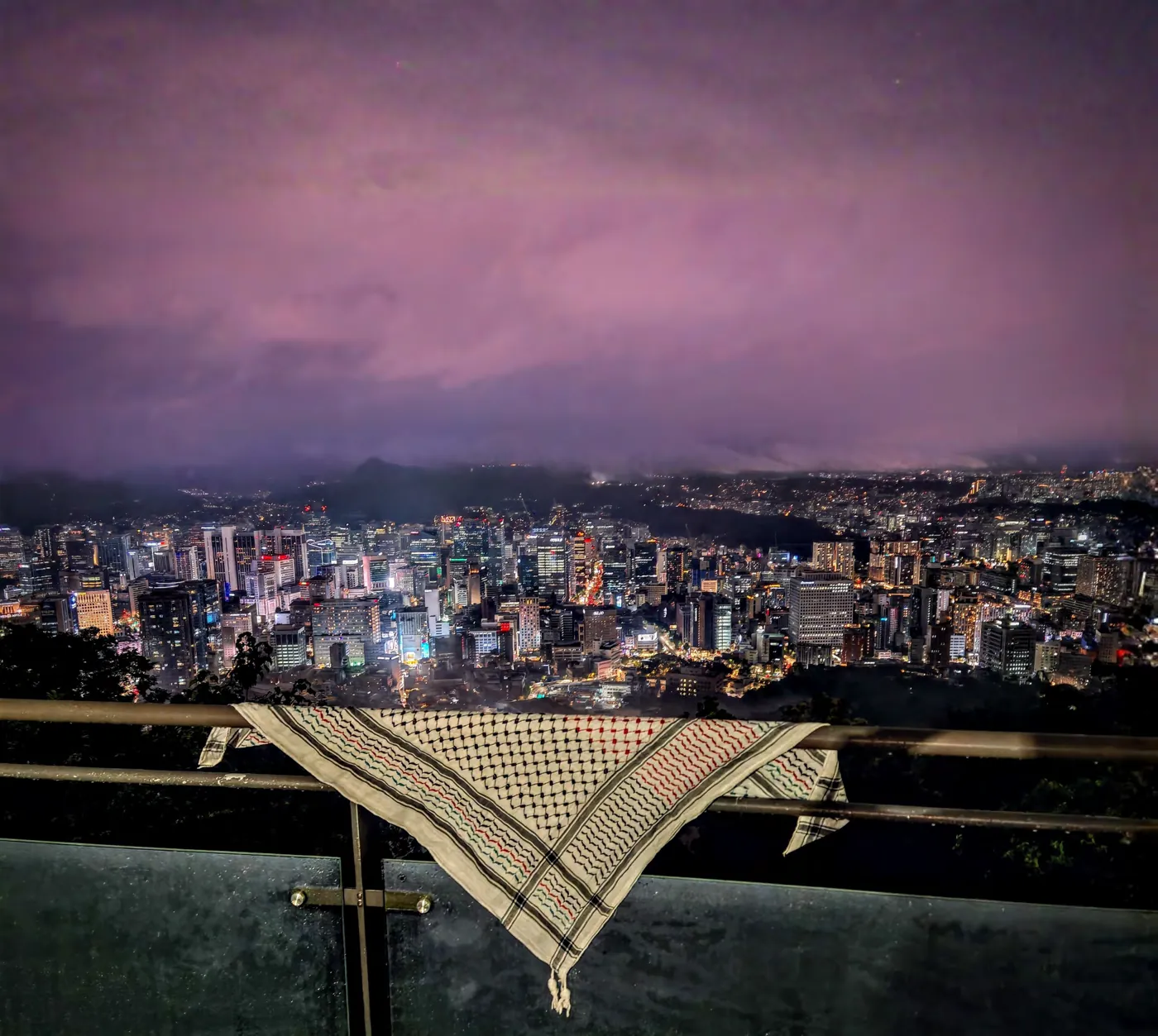
The Cloth in Origin
The kufiyah began as the working cloth of Palestinian farmers. During the Great Revolt of 1936-39 - three years of Palestinian uprising against British colonial rule and Zionist land acquisition - resistance fighters adopted it so that combatants and civilians could not be told apart. The scarf became the equaliser.
The Indian National Congress was watching. On 31 October 1937, the AICC passed a resolution condemning “the reign of terror” by British imperialists in Palestine, offering “the solidarity of the Indian people” to Palestinians “in their struggle for national freedom.”
The next year, in Harijan on 26 November 1938, Gandhi wrote the sentence every generation since has quoted: “Palestine belongs to the Arabs in the same sense that England belongs to the English or France to the French. It is wrong and inhuman to impose the Jews on the Arabs.”
Palestinians were already watching back. In 1929, the year of the al-Buraq Uprising, the Nablus poet Ibrahim Tuqan wrote, half-bitter, half-longing: if only one of our leaders would fast like Gandhi.
One of my scarves is named Saoirse - the Irish word for freedom. Hirbawi weave a kufiya by that name, dedicated to the Irish people, some of the most outspoken European defenders of Palestinian liberty. Ireland was colonised by the same empire that colonised Palestine. The name is a struggle to be alive in places beyond the tongue.
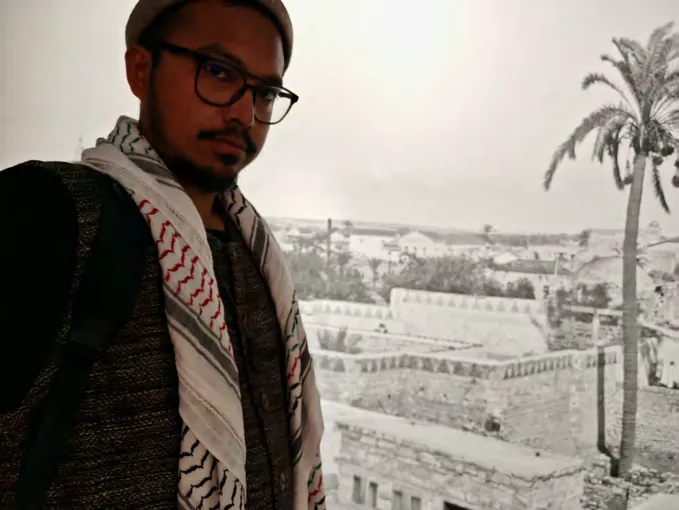
I am British-born. Malay-Malaysian, Sri Lankan, Singaporean, and Filipino by inheritance.
The British left India and Pakistan in August 1947. They left Palestine nine months later, on 15 May 1948. Two partitions, twelve months apart, by the same imperial hand. The subcontinent’s partition displaced an estimated fifteen million people and killed around a million in communal violence. Palestine’s Nakba - the catastrophe - expelled over 700,000 Palestinians and destroyed more than 500 villages in the same calendar year.
The Pakistani writer Eqbal Ahmad - who walked north from Bihar to Lahore in 1947 carrying a gun, and went on to become one of Edward Said’s closest comrades - spent the rest of his life naming this connection: same empire, one year, two ruined exits.
My family ancestry lived through that aftermath. In Johor, where part of my family is from, the British drew the grid in the late eighteenth century. It is still there. I grew up in a household where Palestine was spoken of the way you talk about distant relatives, related through a complex chain of connections, but still family, not as a distant cause, but something you were born into.
Something about this broke me open before I knew enough to explain it. Hearing about broken promises. Deception. Betrayal. Empire. The British. The Israeli Yahudis (Jews). All while Hindustani films played on flickering TV due to poor signal after heavy rain, P. Ramlee on the stereo, and babies cried whilst being bounced to sleep in slings attached to springs hung from vertical stands, as ceiling fans hummed overhead.
Before I tell you where Saoirse has been, I want to tell you what she is made of.
The cotton in a Hirbawi kufiyah comes from a supply chain that occupation shapes at every point. The aquifers under the West Bank - the Mountain Aquifer, the Jordan Valley groundwater - are largely controlled by Israeli water infrastructure. Palestinian farmers access a fraction of what flows beneath their land.
The dyes are imported. When checkpoints tighten, when closures extend, the dye flow slows. The factory weaves with what it can. Every thread carries an ecological fact and a political one. The scarf is evidence before it is a symbol.
Protest is often imagined as an event - placards held at a march, chanting, come rain or shine. But protest is also material. The Hirbawi family going to work every morning in occupied Al-Khalil is a protest. The cloth is protest, woven from whatever the occupation permitted to arrive that week.
The Cloth, in Motion
Bandung, Indonesia. March 2026.
This city hosted the Asian-African Conference in 1955 - the founding moment of Third World solidarity, precursor to the Non-Aligned Movement. Twenty-nine newly independent nations met to name what they had in common: colonisation and the refusal of it. President Sukarno opened the proceedings with one sentence: “This is the first international conference of coloured peoples in the history of mankind.”
Palestine was on the agenda. The conference’s final communiqué included a resolution supporting Palestinian rights and self-determination. Israel - like apartheid South Africa - was not invited, despite Nehru’s attempts to include it. Indonesia blocked the invitation. Formal relations have never followed - though under President Prabowo Subianto, who took office in 2024, that position has begun to soften: Indonesia now signals openness, conditional on Israeli recognition of Palestinian statehood. Even the Bandung consensus is something that has to be carried.
I brought the Hirbawi to the Asia-Africa Conference memorial and laid her across the Palestine Walk sign. Palestine’s flag is there. The kufiyah lay across it.
That was the continuation of something started in 1955 and still unfinished. Palestinian self-determination was on the table at Bandung. Seventy-one years later, the cloth came back.
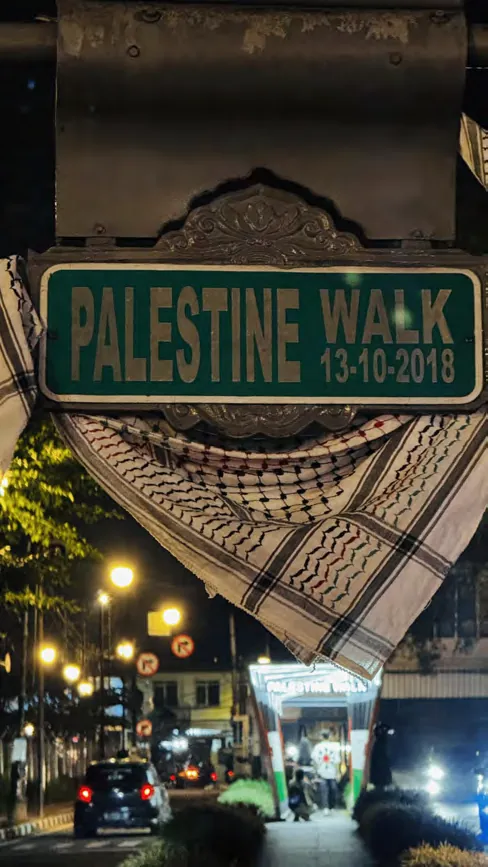
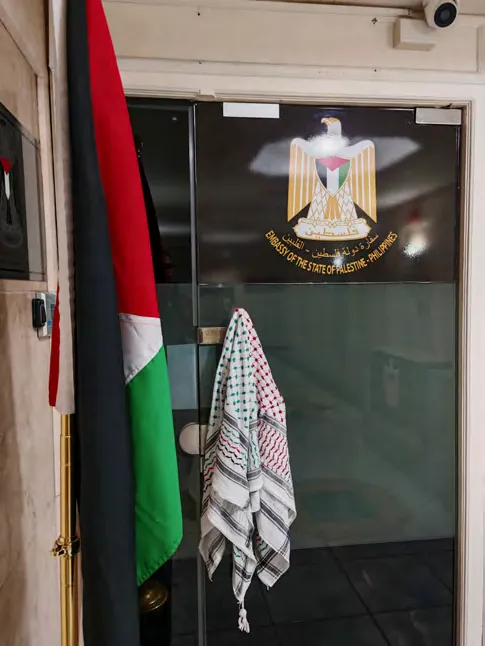
In Manila - shaped by the Spanish empire, then the American empire - the kufiyah arrived carrying what she carried at Bandung: a textile refusing to let decolonisation be declared finished.
Southeast Asia and Palestine have a specific history worth naming. Bandung’s resolution was not theoretical - it was followed by decades of diplomatic refusal, cultural solidarity, and visible material support. The kufiyah passing through these cities is not a new gesture. It is a thread being picked up, and woven again.
London. The city where I was born. The city that administered Palestine under the British Mandate from 1920 to 1948. The city whose government issued the Balfour Declaration in 1917 - a letter from one empire’s foreign secretary to one aristocratic family, promising land that was not theirs to give.
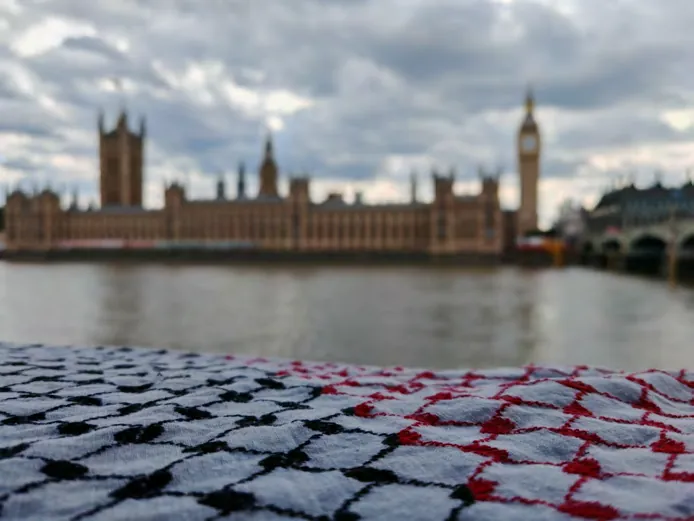
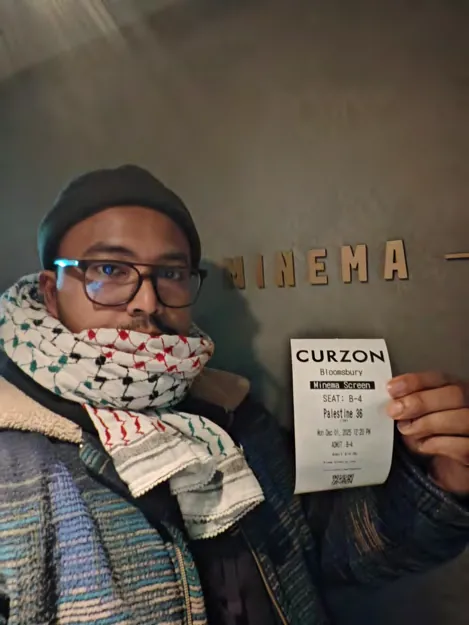
In December 2025, I watched an early showing of Palestine 36 at the Curzon in Russell Square, Saoirse around my neck. As I left, I paused to photograph the poster. A white man in his fifties at a nearby table looked up. “I’ve had enough of this,” he said. He stood up and walked away. I hadn’t said a word.
In Leicester Square, one wet afternoon, Filipinos in London gathered to protest the Marcos-Duterte regime in Manila - the same dynastic families that the United States installed and protected for decades. I stood with them, Saoirse around my neck and on my shoulders. The Philippines is part of my family. So is occupied Palestine. The kufiyah belongs at both kinds of marches.
London is also the city where, in August 1976, a Gujarati woman named Jayaben Desai walked out of the Grunwick film-processing laboratory in Brent and started a two-year strike that became one of the most significant labour disputes in modern British history. Most of the Grunwick workers were South Asian women - many from families twice-displaced by empire: settled in East Africa under British colonial rule, then expelled by post-independence governments in Kenya and Uganda, arriving in Britain holding passports they had been told meant something. Before them, textile workers at Mansfield Hosiery in Loughborough in 1972, at Imperial Typewriters in Leicester in 1974. The East African South Asian population in Britain went from around 45,000 in 1971 to roughly 180,000 by 1981. Empire’s displaced, insisting on dignity through work.
“We have shown,” Desai said at the final strike meeting, “that workers like us, new to these shores, will never accept being treated without dignity or respect.”
The same empire that issued the Balfour Declaration produced the legal conditions for these expulsions fifty years later. The South Asian British community whose grandmothers built that picket line is the community wearing kufiyahs in the streets of this city now. The cloth and the community recognise each other, where words unsaid connect them with histories untold, being re-membered again.
The Cloth, as Record
The cloth is currently in motion to its next destination: Goma, in North Kivu, Democratic Republic of Congo.
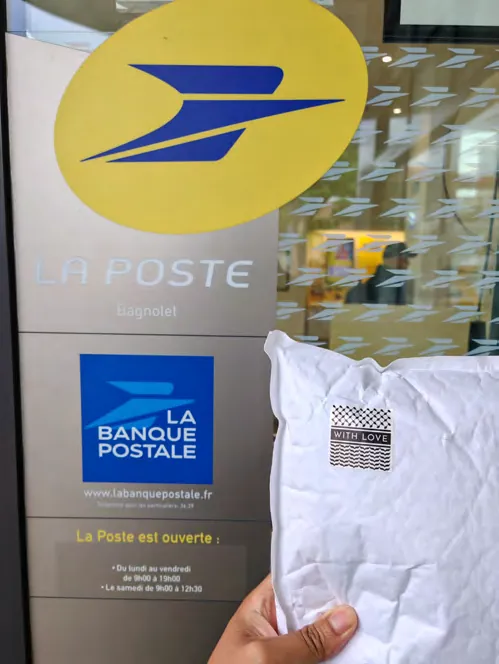
I ran a public competition - an invitation to global communities to engage with Threads of Solidarity, my transnational artivism project documenting the travels of the kufiyah and cultural heritage artefacts as resistance infrastructure. The winner is in Goma. He will receive a Hirbawi kufiyah sourced directly from Al-Khalil, shipped from France, routed via Rwanda, declared on the customs form as what it is: a textile artisanal, a gift. The scarf will arrive in a city where M23 - backed by Rwanda - captured the regional capital in January 2025, where seven million people have been displaced across eastern Congo by armed conflict, where the same global supply chains that fund the occupation of Palestine run through the mining interests that fund the occupation of eastern Congo.
The same systems. The same logic. The same distance between those who extract and those whose land is being extracted from.
A kufiyah woven in occupied Palestine will soon sit in occupied Goma. The route runs through Rwanda, through the country backing the occupation, and will arrive anyway.
On 19 July 2024, the International Court of Justice issued an advisory opinion finding that Israel’s continued occupation of the Palestinian territories - the West Bank, East Jerusalem, Gaza - is unlawful under international law. The occupation as a whole, not specific acts within it, violates Palestinians’ right to self-determination, constitutes racial segregation, and must end. The opinion is not binding. No enforcement mechanism exists. But it names in law what the cloth already knew.
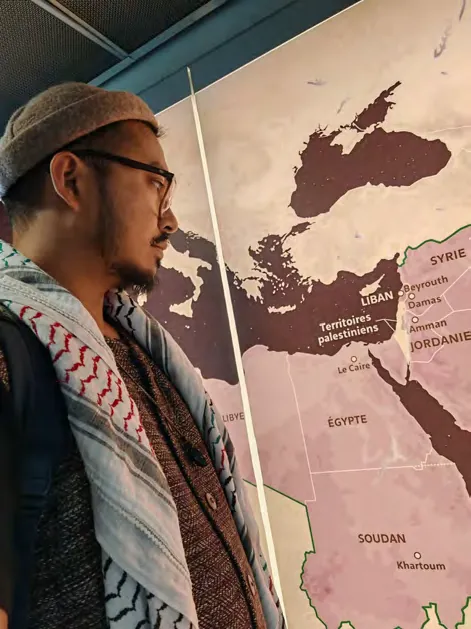
In November 2025 I watched Disunited Nations - Christophe Cottéret’s film on the UN’s failures on Palestine - at a cinema in Les Lilas, Paris. Francesca Albanese, the UN Special Rapporteur on the Occupied Palestinian Territories, signed her book Quand Le Monde Dort (When the World Sleeps) for me. The cloth was in my bag. The legal architecture and the textile arrived in the same room.
Watch Disunited Nations on ARTE ▸
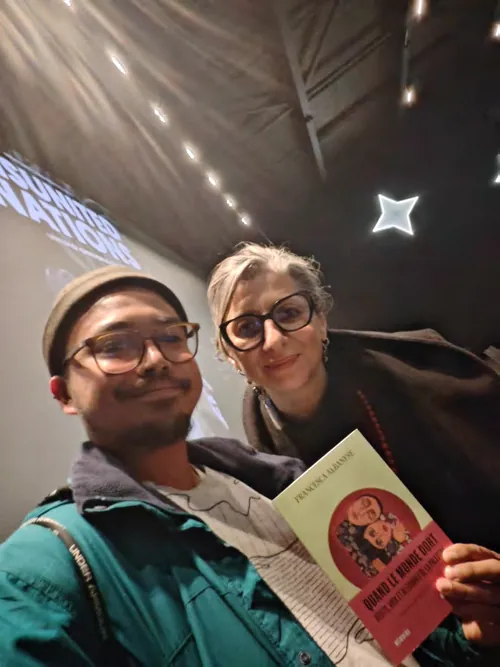
The United States sanctioned her under Executive Order 14203 in July 2025 - the legal architecture is itself now a target. In May 2026, after a federal court ruled the sanctions likely violated the First Amendment, the Treasury removed her from the list. The architecture holds, for now, by court order rather than consent.
The Hirbawi family weaving in Al-Khalil under military occupation since 1967 is doing so inside what the highest legal body in the world has now named as an unlawful situation. The cloth is evidence. The journey is evidence. The archive is evidence.
Protest, at its roots, heart and soul, is the act of refusing to let something be removed, erased, disappeared without consent. The 1937 Congress did it. Bandung did it. Jayaben Desai did it. Kufiyah still does it.
Across borders, cities, and seas. The same cloth, still here. What the cloth carries is a record of memory. We re-member, and we will be free.
Who will hold it next?The Call
Out the window
The moon shines
My wing blinks
My heart calls for what’s
behind
Down below
We look up
With hands together
Hoping for rain
to wash the pain
the blood
the tears that trace our fears
that aged our land.
Running years
turning gears
Searching for the summit
Till we found each other.
Like a blanket on a cold night
Truth wrapped in light
Our spirit takes flight.
Razali Samsudin is a British-born writer and civic technologist of Malaysian, Sri Lankan, Singaporean, and Filipino heritage. He leads the Civic Tech and Digital Sovereignty team at Tech for Palestine, and founded Manifest Studio Collective (manifeststudio.org). The journey is documented at threadsofsolidarity.com.
Pages 138 to 143 as printed. Tap a page to open it, then tap again to zoom.
This essay appears in In Protest, Issue 3 of Cosy Desi Club. Print copies support the magazine and its contributors.
Buy the print issue